After a long hiatus from writing, I take a completely different direction focused on artists and technically excellent people. And that is because a naked appreciation of human art seems to escape our daily experience due to the AI SLOPlosion; and thus, inadvertently deprives us of awareness of what humans can do.
This article is my attempt to create a cognitive theory and formalize an objective framework that allows the identification of virtuosos and inspect how they are revered as gods.
*Virtuosity traces back to the Italian virtuoso (meaning “skilled,” “learned,” or “of exceptional worth”) and the Latin virtus (“manliness,” “excellence,” or “valor”). Oddly, the word’s origins are a little morality centric, possibly because of blurred boundaries between a person’s worth, their status in society, and even their ability to contribute. I am divorcing those connotations from this framework.
- Short version
- The 8-dimension model of virtuosity model
-
Longer version for those who really want to see how we can operationalize these dimensions and what philosophers said
- 1. Cognitive loop
- 2. Demonstrability of the embodied cognitive loop
- 3. Technicality / performance benchmark
- 4. Aesthetic overwhelm
- 5. Labor and motivation to optimize labor
- 6. Final form of the artist
- 7. Aesthetic/performance rarity (Defining or replicating an aesthetic or performance)
- 8. Skill acquisition cost, depreciation, and aids
- Core dimensions of virtuosity across different levels of ability
Short version
A virtuoso is a technically supreme artist who violates expectations and creates aesthetic overwhelm via a cognitive loop between themselves and their instrument, tool, or physical extension of the body.
They are psychologically merged with their tool and so knowledge of the tool and knowledge of how they can manipulate it is their sense of cognitive fluency within that body-tool-mind loop. Yngwie Malmsteen’s neoclassical shred and Mark Knopfler’s hand-picked dynamics are 2 contrasting virtuosities with extremely different technical achievements yet a comparable level of being oneness with the guitar.
The loop must be active, at least necessarily during the demonstration of virtuosity, although it can also be demonstrated during practice or training. The theory must therefore allow something like a prosthetic to be an instrument integral to being a virtuoso. At the same time, it excludes cognitive functionality like sustained attention or logical thinking from being sufficient criteria by themselves.
Aesthetic overwhelm must be created either through the process or the outcome of the art, or through both. The art may still be judged unattractive in the sense someone may think that a virtuoso is making ugly music or ugly sculptures but they cannot deny the power of their aesthetic. The point is not beauty or audience liking. The point is that the process, outcome, or both surpass a commonly expected benchmark set by the general expert.
Labor is also a necessary condition to achieve virtuosity. Motivation to optimize that labor is also necessary. The labor earns capabilities at a higher level, pushes technical boundaries, and proves what can be achieved. Being born a genius or arriving at an accidental innovation can be catalysts, but they are not sufficient criteria for being a virtuoso.
The final form of that labor results in a flavor of aesthetic, or multiple flavors. These flavors must have some uniqueness, whether small or large, and that uniqueness must originate from the artist. The final form can also be a unique concept in itself, as long as it has perceivable elements and does not require the perceiver’s subjective judgment to exist.
A virtuoso either defines or replicates an aesthetic and performance. The cost of becoming a virtuoso cannot be depreciated over time or overcome easily. This allows a virtuoso who does not innovate but replicates the skills of the rarest of the rare virtuosos, such as being only the second person to achieve something. Even the 199th person could be a virtuoso if the labor required remains comparable.
However, if the same achievement requires less labor today because the field has advanced, because pedagogy has improved, or because skill acquisition has become easier, then the benchmark for virtuoso must be raised. Mathematics is only a convenient contrast here because mathematical skill from the 1800s to the 21st century has advanced and become easier to acquire in some respects, but mathematics fails the necessary criterion of including a physical instrument, tool, or extension in one embodied cognitive loop with the artist.
An artist using aids or supportive factors to achieve an already achieved benchmark is disqualified when those aids replace the cost of skill acquisition. But the use of aids does not disqualify the artist when the benchmark scales with the aid.
The rule is: cost of skill acquisition cannot be replaced with aids. The use of aids is valid only if the benchmark scales with it.
The 8-dimension model of virtuosity model
I would then say that virtuosity is a function of 5 core dimensions, 1 filter criteria, and 2 modulatory dimensions.
- Core dimensions: Cognitive Loop, Technicality, Aesthetic Overwhelm, Labor, and Final form describe the actual virtuosity “signal”.
- Conditional dimension: Demonstrability is a defense against illusion, deceit, or false marketing that propagate the idea of virtuosity without the evidence.
- Modulatory dimensions: Aesthetic rarity, and Skill acquisition cost describe whether the virtuosity of an artist is the first of its kind, a rare replication, or is now easily achievable/unachievable due to society & civilization level changes such as learning via the internet or methodical refinement of techniques and tools.
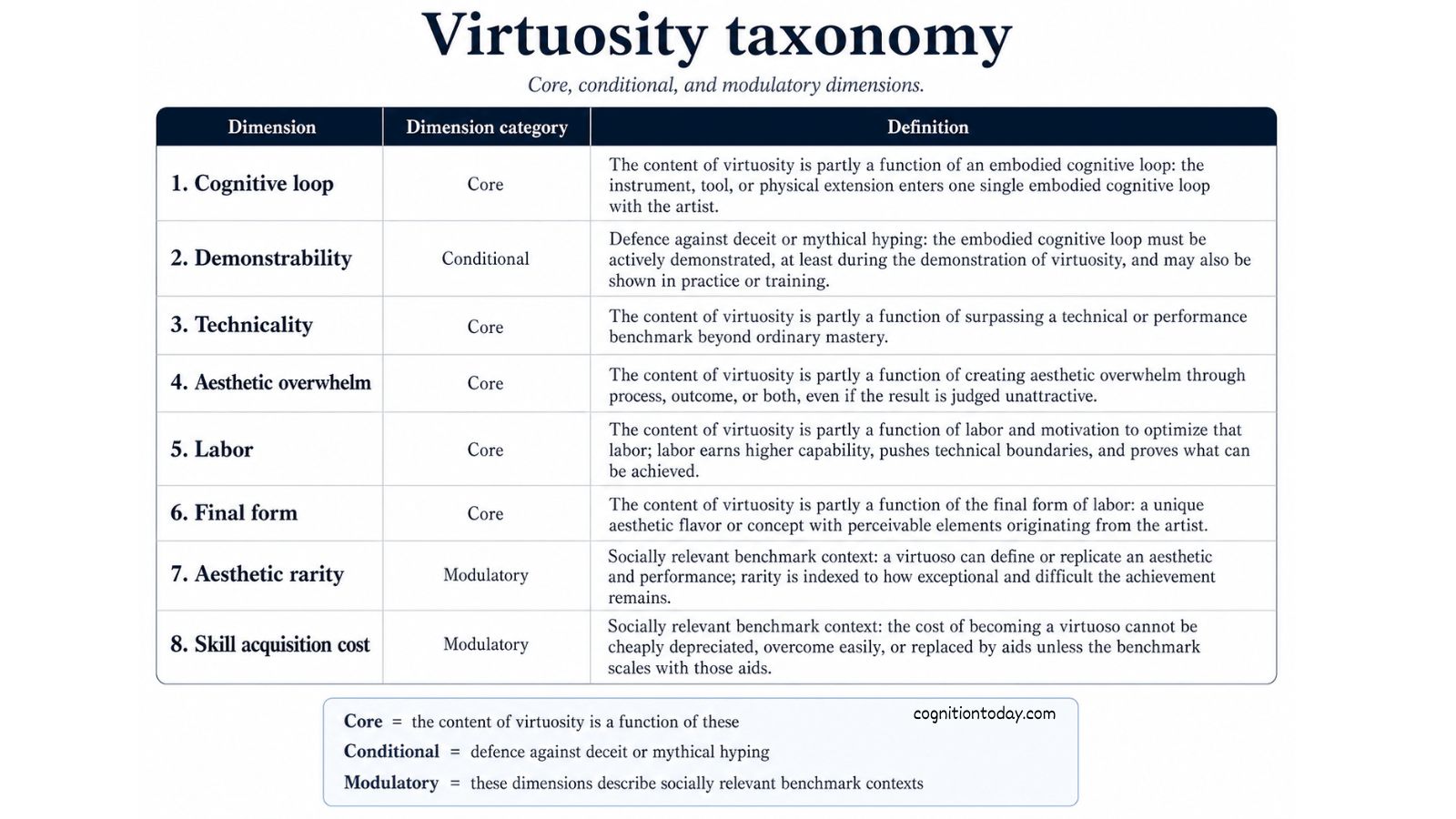
Longer version for those who really want to see how we can operationalize these dimensions and what philosophers said
Each section has inclusions and exclusions that are heuristics to judge if a particular dimension of virtuosity is present or not.
1. Cognitive loop
The instrument, tool, or physical extension of the body is in one single embodied cognitive loop with the artist.
Knowledge of the instrument and knowledge of how to manipulate it are an extended form of cognition and body. The instrument is not outside the artist in the relevant moment. It is part of the artist’s functioning cognitive-body system.
This is the necessary structure that makes virtuosity different from general intelligence, abstract reasoning, sustained attention, or logical thinking. Those capacities may support virtuosity, but they do not become virtuosity unless they are expressed through an embodied cognitive loop with a physical instrument, tool, or extension.
A special case of this loop is using prosthetics or physical cybernetic enhancements within the body because they would be a novel tool that must seamlessly integrate into a physical-cognitive loop. E.g., a person who plays technical guitar with a mechanical arm must’ve already entered a cognitive loop with the mechanical arm and also gone through the training and labor to achieve dexterity (point 5)
Inclusion: a guitar, violin, bow, loom, brush, camera, prosthetic, modified apparatus, or other physical system can qualify if it enters the artist’s embodied cognitive loop.
Exclusion: sustained attention, logical thinking, abstract reasoning, strategic intelligence, or memory do not qualify by themselves because they lack the required embodied instrument-mediated loop.
Martin Heidegger’s idea of readiness-to-hand is similar. He said, because the mastered tool stops appearing as an external object during action, it is an extension of the body. The guitar, bow, loom, brush, prosthetic hand, or drum pedal becomes part of the artist’s practical body.
2. Demonstrability of the embodied cognitive loop
The embodied cognitive loop must be active, at least necessarily during the demonstration of virtuosity.
This demonstration does not have to mean only a formal performance. It can also appear during practice or training. The point is that virtuosity is not merely an inner possession. The loop has to be active as an ongoing behavior/action. Otherwise, it is likely a deceit, marketing gimmick, scam, or public hype akin to hyping a mythical fictional being.
A virtuoso does not stop being relevant outside the stage even though offstage shows them with less expected flair. If the embodied cognitive loop is active and the other criteria are met, virtuosity is observed before, during, or outside public performance, even when voyeuristically peeking at individual recorded stems out of musical context or naturally observing an educational session. In this sense, virtuosity is observer-agnostic.
Inclusion: performance, practice, training, process, or outcome can demonstrate virtuosity.
Exclusion: a hidden claim of ability without active demonstration does not carry enough force.
3. Technicality / performance benchmark
Virtuosity must surpass a commonly expected benchmark.
This benchmark is technical, performative, or both. It cannot be ordinary expertise. It cannot be merely competent professional skill. It has to exceed the expected range for serious practitioners in the relevant domain and therefor judged as extremely difficult, rare, and profoundly skilled. Something like 3 standard deviations, although I would consider a reasonable 4 standard deviations in highly popular domains like playing musical instruments.
The benchmark must also be appropriate to the form. A technical benchmark should be judged by technical acquisition cost. A performance benchmark should be judged by what the specific performance system requires. The benchmark has to match the claim.
Inclusion: rare control, rare technical achievement, rare performance achievement, or rare domain-specific difficulty.
Exclusion: general impressiveness, ordinary mastery, charm, charisma, or beauty without the relevant benchmark.
4. Aesthetic overwhelm
Aesthetic overwhelm must be created either through process, outcome, or both.
Help me run this site with a donation :)

Even though it is an “overwhelm” in some mental or sensory way, it doesn’t have to beautiful or attractive and can be fairly judged as unattractive. The criterion is not prettiness, beauty, taste, or subjective liking but rather something about the process, the outcome, or both that exceeds normal expectations and produces aesthetic force.
It must feel or appear beyond the normal range of what that instrument, tool, body, or physical system is expected to do.
Inclusion: aesthetic overwhelm through process like a demo; aesthetic overwhelm through outcome like a song; aesthetic overwhelm through both a live performance.
Exclusion: attractiveness alone; audience liking alone; subjective preference alone; emotional appeal without benchmark-surpassing force.
Immanuel Kant’s sublime is similar to aesthetic overwhelm because the relevant experience is not ordinary beauty. Virtuosity often produces the sense that a limit has been crossed: too complex, too precise, too delicate, too dense, too controlled, too physically unlikely, or too strangely expressive. Audience approval is not required. The overwhelm belongs to the perceivable structure of the process or outcome. A person can dislike the work and still recognize the excess.
5. Labor and motivation to optimize labor
Labor is necessary.
The artist directs labor toward higher capability, sharper control, better manipulation, stronger performance, and a more refined command of the embodied cognitive loop. The end result is fluency at the very least and un-imaginable novelty executed effortlessly at its peak.
The reason I say motivation to optimize labor also is necessary because the progress in skill execution requires increasing effort especially near a high benchmark and requires a conscious purposeful adjustment to that labor to optimize one’s training to improve. This optimization is primarily a deeply analytical and creative process where the artist decides what and how to optimize. Such moments often lead to techniques to learn something that others adopt to improve their own imitation of the virtuoso’s skill level. In contrast, decades worth of labor with no optimization will likely lead to plateaued fluency but not cross boundaries of the art itself.
The labor earns capabilities at a higher level. It pushes technical boundaries and proves what can be achieved. But in contrast, being born a genius is not sufficient. Genius can be a catalyst. It can accelerate learning or open possibilities, but it cannot replace the labor requirement because that creates a baseline unfair advantage. In this sense, there is a longer “process” of becoming a virtuoso. That is, my definition of a virtuoso requires an experience-based purposeful enhancement of skill and not just be a target that can be achieved.
Accidental innovation is also not sufficient. Accident can catalyze discovery, but it does not become virtuosity unless the artist turns it into controlled, repeatable, optimized capability.
Inclusion: labor, optimized labor, earned higher capability, boundary-pushing, repeatable execution.
Exclusion: born genius alone; accidental innovation alone; laborless demonstration of capability; novelty without optimized command.
John Locke and Karl Marx said a lot about labor. Locke’s theory of labor mixing and Marx’s labor theory of value are similar ideas to what I say about virtuosity stores labor in the body and in the performed object. Friedrich Nietzsche’s self-overcoming concept makes the same point: the virtuoso is not merely gifted, but someone who has forced the body past ordinary limits through disciplined transformation. Baldassare Castiglione’s sprezzatura spoke of “effortlessness” in the same way we often look at a skilled artist and think how difficult their craft is but for the artist, the highest skill hides its own history of effort.
6. Final form of the artist
The final form of that labor results in a flavor or texture of aesthetic uniquely derived from the artist’s idiosyncrasies and decisions.
These flavors must be defined with uniqueness. The uniqueness can be small or large, but it must originate from the artist.
The final form can be a unique concept in itself. But it must have perceivable elements, like Tosin Abasi’s thumping technique. It cannot depend only on the perceiver’s subjective judgment. The uniqueness must be present in the work, process, performance, or outcome in some perceivable form.
This is not the same as aesthetic overwhelm. Aesthetic overwhelm is the force or excess created through process or outcome. Artist-originated final form is the unique flavor or concept that results from the artist’s labor. Something of a signature that becomes a legacy.
Inclusion: unique aesthetic flavor, multiple stylistic elements, micro-signature, large signature, unique concept, perceivable artist-originated elements.
Exclusion: uniqueness that exists only because an audience says so; uniqueness based only on biography, branding, or subjective interpretation.
Aristotle’s idea of arête, or excellence, gives the word its deeper moral-aesthetic nuance. A virtuoso does not merely perform a task competently. Rather, the artist realizes the capacity of a medium at an unusually high level. The Greek distinction between techne and phronesis also differentiate a very important nuance of the virtuoso’s cognition involving their art. Techne is knowledge of the craft. Phronesis is practical judgment. A virtuoso needs both: difficult technique and the judgment to place that technique inside an aesthetic act.
7. Aesthetic/performance rarity (Defining or replicating an aesthetic or performance)
A virtuoso either defines by themselves or replicates an aesthetic/performance that is rare-enough to be worthy of replication.
Assuming that a virtuoso will have their own style seems obvious but a special case emerges when the virtuoso is not the originator of a style. A virtuoso who does not define their own uniqueness can still meet the criteria if they replicate the skills of the rarest of the rare virtuosos and if the cost of achieving that replication remains comparable.
Being the second person to achieve something can still qualify. Even being the 199th person can qualify if the labor required remains comparable with 100,000 people failing.
Still, most virtuosos, are likely to bring out their own flavor. And there may be cases where a flavor offered by a virtuoso is so idiosyncratic replicating it seems impossible, yet someone manages to reverse-engineer it and replicate it. Like figuring out how to sound like Santana.
Inclusion: defining an aesthetic and performance; replicating an aesthetic and performance at comparable acquisition cost; being second or later while still facing comparable labor.
Exclusion: cheap imitation; surface replication; copying an already achieved benchmark after the cost has fallen substantially.
8. Skill acquisition cost, depreciation, and aids
The cost of becoming a virtuoso cannot be depreciated over time or overcome easily.
If the same achievement becomes easier because the field has advanced, because methods have improved, or because the acquisition path has become easier, then the benchmark for virtuoso must be raised. Over time, effort to acquire a certain level of proficiency directly reduces because of human society elements like teachers, coaching, people studying and dissecting someone’s skill, and even creating new techniques/tools to acquire them. This is the same as Jimmy Hendrix innovating playing dynamics with his style of mixing rhythm with melodic licks. A generation of guitarists heard that, learned that, and created tabs for others to learn, which then entered common guitar vocabulary.
Mathematics is a useful contrast. Mathematical skill from the 1800s to the 21st century has steadily increased because the field has advanced and the ease of acquiring earlier skills has changed. The same achievement may require less labor today, so the benchmark must rise. But mathematics is only a convenient example because it fails the necessary criterion of including a physical instrument, tool, or extension in one embodied cognitive loop with the artist.
This also applies to aids.
An artist using aids or supportive factors to achieve an already achieved benchmark is disqualified from this criteria if those aids replace the cost of skill acquisition. But the use of aids does not disqualify the artist when the benchmark scales with the aid.
Inclusion: aid use where the artist still bears the relevant acquisition cost; aid use where the benchmark rises accordingly; prosthetic use where the prosthetic is part of the embodied cognitive loop.
Exclusion: aids that replace the specific micro-technique; aids that lower the cost of entry for an already achieved benchmark without raising the standard; support factors that bypass the labor required to claim virtuosity.
Core dimensions of virtuosity across different levels of ability
| Descriptor | Cognitive loop | Technicality | Aesthetic overwhelm | Labor | Final form | Interpretation |
|---|---|---|---|---|---|---|
| Virtuoso | ✅ | ✅ | ✅ | ✅ | ✅ | Full positive case across all core dimensions. |
| Non-case | ❌ | ❌ | ❌ | ❌ | ❌ | No meaningful case for virtuosity. |
| Iconoclast | ✅ | ❌ | ✅ | ✅ | ✅ | Strong embodied practice, overwhelm, labor, and artist-originated final form, but not clearly a rare technical/performance benchmark. |
| Expert | ✅ | ✅ | ❌ | ✅ | ✅ | High control, labor, and artist-originated final form, but deliberately restrained or non-overwhelming in aesthetic force. |
| Technical expert | ✅ | ✅ | ❌ | ✅ | ❌ | Rare technical/performance control earned through labor, but lacking strong aesthetic overwhelm and artist-originated final form. |
| Scammer / false marketing | ❌ | ❌ | ✅ | ❌ | ✅ | Markets spectacle or uniqueness, but the core causal structure of virtuosity is missing. |
| Expressive stylist | ✅ | ❌ | ✅ | ❌ | ✅ | Recognizable and compelling style with overwhelm and final form, but weak evidence of rare technicality and optimized labor. |
| Competent practitioner | ✅ | ❌ | ❌ | ✅ | ❌ | Real embodied practice and labor, but below the virtuoso threshold in benchmark, overwhelm, and final form. |
P.S. This entire article’s analysis was done with examples of guitarists and dissecting their work and making it make sense to another artist.

Hey! Thank you for reading; hope you enjoyed the article. I run Cognition Today to capture some of the most fascinating mechanisms that guide our lives. My content here is referenced and featured in NY Times, Forbes, CNET, and Entrepreneur, and many other books & research papers.
I’m am a psychology SME consultant in EdTech with a focus on AI cognition and Behavioral Engineering. I’m affiliated to myelin, an EdTech company in India as well.
I’ve studied at NIMHANS Bangalore (positive psychology), Savitribai Phule Pune University (clinical psychology), Fergusson College (BA psych), and affiliated with IIM Ahmedabad (marketing psychology). I’m currently studying Korean at Seoul National University.
I’m based in Pune, India but living in Seoul, S. Korea. Love Sci-fi, horror media; Love rock, metal, synthwave, and K-pop music; can’t whistle; can play 2 guitars at a time.
Help me run this site with a donation :)