I first learned the concept of nunchi in a Korean business class. It was introduced as a core Korean business skill of understanding a situation and context when words are not used to describe intent. Loosely, I would call it a type of presence of mind, but the closest translation of Nunchi I can think of is “Measuring with the Eyes” (눈= nun (eyes) 치 = Chi (measurement, sizing-up)). It’s a clean judgment and evaluation that builds up into the top-level skills of reading the room, anticipating others, and acting before things become awkward or inappropriate.
At the time, it sounded abstract. And then, just when I had begun settling down in Seoul and hanging out with Korean locals, who welcomed me into their everyday life, my guiding force for correct behaviour and communication was Nunchi. This was a forced choice because – if I had developed enough korean language skills, I then would’ve often used language, the way you’d ask “would you like another drink?” vs. pouring someone a drink just when you notice they glanced at it and realized the glass is empty.
Since I quit my language school classes to pursue something else (you’ll hear about it next year), my Korean proficiency plateaued at a pretty low level. That fact shaped my experience more than anything else. I couldn’t rely on language to integrate smoothly, or clarify intentions, or ask for guidance in social settings. So instead, I had to rely on something else – Nunchi. Regardless of whether I had it previously or not. The absence of language forced my attention on things I rarely noticed.
First, the technicals:
Nunchi has 3 cognitive requirements for it to be a usable skill:
- Attention to holistic as well as specific contextual information present in the moment. E.g., the people, the location, the general assessment of mood, and the contents of conversation.
- Knowledge/Memory of a situation and culture. Since nunchi involves paying attention AND making decisions, those decisions have to be guided by signals from the environment, and those decisions have to translate into actions governed by cultural knowledge. So, effective Nunchi requires sensitivity to the culture in an environment. And this culture can be any kind – national, local, office, friendly, dating, post-work, etc.
- Decision-making “responses” aka actions directly associated with the observations you make. These are the most crucial aspects because just observing and being mindfully aware is largely meaningless if an action does not follow the thought process.
I’ll explain all 3 of these in 2 common experiences I have in our bar/restaurant hangouts.
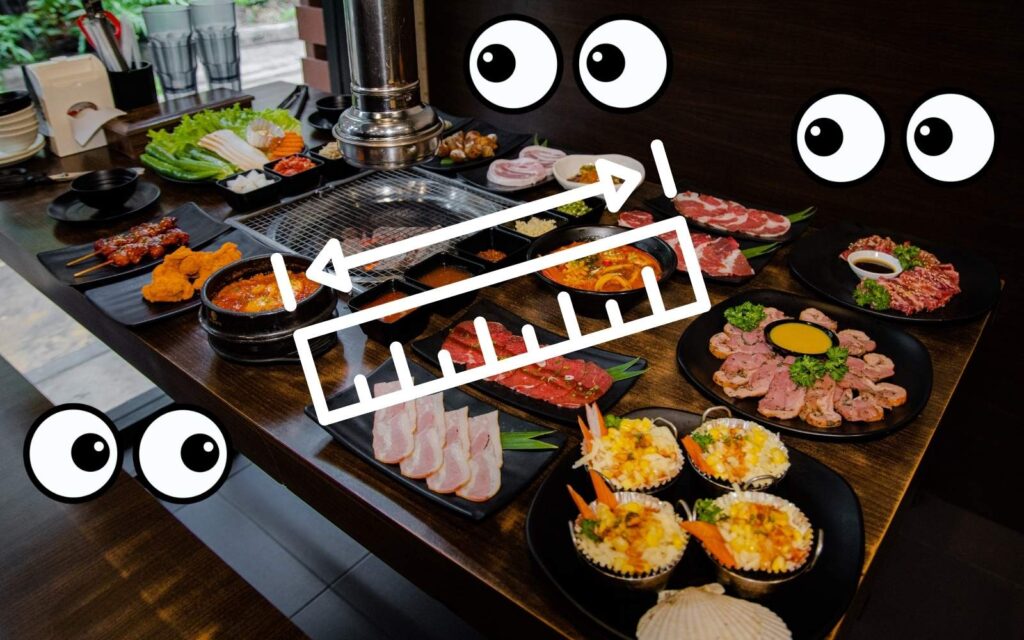
Eating a shared common meal
In many shared-meal situations, especially when alcohol is involved, there are unspoken expectations based on age and average closeness to members of the group. Often, I was the oldest at the table, which often signalled to me what expectations are held of me. When a shared food item arrived (like chon or dalkgalbi, something everyone would eat from the common plate or by transferring to their own plate), I noticed all others would wait. Not because of initial awkwardness to eat first or that I am the only foreigner at the table; but because there were expectations, which a friend literally clarified to me in English. If I didn’t eat, no one else could comfortably start eating. The oldeset one takes the first bite.
So if I waited too long, thinking I was being polite, I was actually blocking everyone else. Nunchi, in that situation, meant noticing subtle impatience, glances toward the food, and slight shifts in posture. Someone wanted to eat. So I had to act quickly. Like take a small bite, just enough to signal that the food is ready for everyone’s consumption, and then step back. Once that happened, the atmosphere relaxed immediately. People drank. People ate. The moment passed.
Seating arrangements while eating/drinking
In group settings, seating isn’t random. There’s a quiet architecture that considers who is new, who is closest, who should sit where, etc., so everyone feels comfortable. This doesn’t always sort itself out organically. Someone has to intervene. I saw it a few times, and I never realized that it is actually quite a natural thing to do. This process of arranging ourselves around a table generally ensures everyone is comfortable, not feeling excluded, and everyone feels “accessed” and “important”.
The seating arrangement nunchi is kinda an advanced form of nunchi because it requires someone to understand the whole group’s dynamic, and that sort of decision-making requires information that is not present in real-time, such as inter-member comfort and history. But real-time signals do help – You notice hesitation. You see someone unsure where to sit. You recognize who should be closer, who needs space, and who should be treated as a guest. Then you guide it by literally asking someone to sit down, and others with nunchi organically sit around comfortably in a socially optimized way.
How you can cultivate Nunchi
All of this may feel like mental calculations, but it really is just a very instinctive form of social behavior that optimizes for average comfort.
Again, no one explains this. You either sense it or you make mistakes and learn by observation.
Surprisingly, there are no steps or instructions to develop Nunchi. You have to force it out of circumstance.
Because my language skills were weak, I had no choice but to rely on non-verbal cues. Body language. Cultural expectations. Overall energy. Tone shifts. How responsive people were to each other. Who deferred. Who hesitated. Who acted quickly and who waited.
Over time, this became my primary way of understanding people.
Help me run this site with a donation :)

Ironically, being linguistically handicapped sharpened my awareness. I literally didn’t have the words in my head to communicate, so I minimized the need for conversation to reach a goal. I had to pay attention. I had to observe patterns, reactions, and timing. I had to notice what wasn’t said.
It is a sort of sensitivity to the social field you’re in, and I would, quite enthusiastically, suggest you put yourself somewhere you are clearly disadvantaged.
Be in a place where you don’t speak the language well. Where you don’t know the rules. Where you can’t rely on explanation or clear communication.
I think back to a rudimentary definition of language – a signal (often a sound) or a series of signals that are purposefully used to modify others’ behavior in a predictable way. If I make a sound to make you stop and look around while walking, I would’ve then communicated meaningfully through language. With this as my reference, I will say the following:
When your language ability drops, attention and interpretation become more important. You start tracking things you normally ignore.
Nunchi surprisingly develops well as a byproduct of a handicap created by not using the easier option of communication. Outlaw words. You’ll be forced to compensate by sharpening Nunchi – your observational presence of mind.
Happy New Year, and see you next year! 새해 복 많이 받으세요
For a more psychology-centric understanding of observation, I recommend this article.

Hey! Thank you for reading; hope you enjoyed the article. I run Cognition Today to capture some of the most fascinating mechanisms that guide our lives. My content here is referenced and featured in NY Times, Forbes, CNET, and Entrepreneur, and many other books & research papers.
I’m am a psychology SME consultant in EdTech with a focus on AI cognition and Behavioral Engineering. I’m affiliated to myelin, an EdTech company in India as well.
I’ve studied at NIMHANS Bangalore (positive psychology), Savitribai Phule Pune University (clinical psychology), Fergusson College (BA psych), and affiliated with IIM Ahmedabad (marketing psychology). I’m currently studying Korean at Seoul National University.
I’m based in Pune, India but living in Seoul, S. Korea. Love Sci-fi, horror media; Love rock, metal, synthwave, and K-pop music; can’t whistle; can play 2 guitars at a time.

We now rely on your support to run this site. Please donate if you find it useful:)
Help me run this site with a donation :)