Having recently gone through Korean language training as a native English speaker, I’ve noticed some basic habits you can adopt to learn a language faster that aren’t necessarily full-blown study routines. These are for those of you who cannot study a language full-time and still need to see some progress.
I’ve defined these tips based on the principles of how the brain learns and modified common tips to suit someone with a full-time job.
Level: 2.5 out of 6 or B1 equivalent, basic knowledge and familiarity are necessary.
1. Spacing
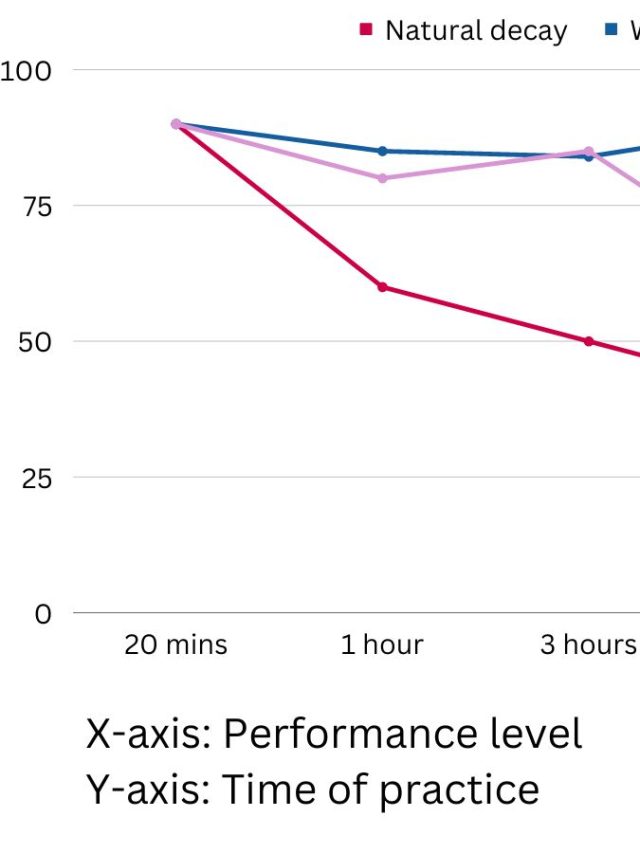
Review and recall facts and small details with a time delay between review and recall. Increase the delay progressively. This reinforces raw memory and counters the forgetting curve.
| Skill | Practical Tips |
|---|---|
| Listening | 1. Re-listen to the same audio after a day, then after 3 days, then a week. 2. Listen to new audio about the same topics on YT so there is randomly spaced repetition of known words. |
| Reading | 1. Review your reading notes after 1 day, 3 days, 7 days. 2. Read, re-read. Read again. |
| Writing | 1. Revisit your previous write-ups after a few days and edit them for clarity. 2. Write short keyword/summary notes at spaced intervals to reinforce recall of prior concepts. |
| Speaking | 1. Do mental rehearsals and then speak them out before you sleep. 2. Use a “review day” as often as you can to speak everything you’ve written and read. |
2. Interleaving
Learn concepts and examples in a mixed fashion instead of in an ordered way. Mixing improves conceptual understanding and intuition.
| Skill | Practical Tips |
|---|---|
| Listening | 1. Listen to conversations related to the office, restaurants, banking, etc. within a short span 2. Depending on your fluency, choose a mix of topics like cooking, colors, travel, etc. |
| Reading | 1. Once you learn different groups of words (like furniture, household objects, body parts), rehearse them together in a self-made glossary. 2. Switch back and forth between pages and “spot check” things you’ve already learned. |
| Writing | 1. Create quick notes of a mixed format of sentences, either in a notebook or in chat. 2. Use at least 3 recently learned aspects of language you learned in 1 single sentence or paragraph. |
| Speaking | 1. Create “do-or-die” sentences that are the most basic, accurate representations of something you’ve learned. Create a list of those. Then reference that list and speak each item in a random order. 2. Create vocabulary chains (5 animals -> 1 to 10 numbers -> 5 professions). Repeat them freely. |
3. Retrieval Practice
Memorizing and remembering are different processes. So the proof of learning is whether a memorized detail can be recalled. Practice recalling.
| Skill | Practical Tips |
|---|---|
| Listening | 1. After listening, recall what was said. 2. Summarize the audio aloud without replaying it. |
| Reading | 1. Close the book and list the vocabulary from memory. 2. Use flashcards or a short self-made glossary to recall key vocabulary and grammar. |
| Writing | 1. Say the same thing to multiple friends without copy-pasting. 2. While learning new vocabulary, continue using old vocabulary while chatting. |
| Speaking | 1. Utilize exact sentences you’ve learned while writing or reading. 2. Pretend you are not reading but speaking to a person. Use a known passage so you can be fluent. |
4. Metacognition
Meta-cognition is reflecting on study material, connecting it to the real world, re-studying it from a different source, analyzing errors, making mental connections between concepts. This strengthens all aspects of learning.
| Skill | Practical Tips |
|---|---|
| Listening | 1. Ask these after you hear a passage: Who is in it? What is it about? What is happening? 2. Wait for cues and try to expect what is going to come next. Re-listen to verify. |
| Reading | 1. After reading, go back and identify the people, themes, actions, facts, etc. in the passage. Then re-read. 2. Do small online reading tests and review your answers. |
| Writing | 1. Discuss the confusing parts online in a forum 2. Have imaginary conversations in your head and write down a response. |
| Speaking | 1. Analyze the “phonetic blocks” and speak them out or record them as voice notes. 2. Self-question mid-speech: “Am I being clear? Concise?” |
5. Chunking
Chunking is grouping information together based on similarity and category. Chunking increases the ability to remember short-term and long-term, and makes information more meaningful.
| Skill | Practical Tips |
|---|---|
| Listening | 1. Go sentence by sentence as if each sentence has a singular purpose. 2. Notice word associations – delicious food, freak accident, Tall basketball player |
| Reading | 1. Group related sentences into one conceptual unit. 2. When you notice something familiar in a new passage, go back and trace where you saw the same thing so you can “group” those together. |
| Writing | 1. Draft paragraphs by theme instead of chronological flow. 2. Use bullet clusters for ideas before converting to full text. |
| Speaking | 1. Practice phrases (“on the other hand,” “to sum up”) as speech units (applies to most languages). 2. Rehearse 3-4 sentence “idea blocks” instead of single sentences. |
6. Scaffolding & Solution Reveals
Scaffolding starts with high amounts of guidance and progressively reducing it to zero. Solution reveals help students understand the methodology and expected answers.
| Skill | Practical Tips |
|---|---|
| Listening | 1. Use subtitles 2. Begin with slow audios, gradually increase to native speed. |
| Reading | 1. Use guided summaries at first, then write them independently. 2. Practice with annotated texts, then move to raw articles. |
| Writing | 1. Use prompts or templates initially, then write freeform. 2. Practice typing with autocorrect, then disable it. |
| Speaking | 1. Use scripted dialogues, then improvise variations. 2. Use the other person’s spoken sentence to create a simple response. “E.g., Do you like coffee?” -> “Yes, I do like coffee, and also tea.” |
7. Variation & Feedback
High variation in the type of solved problems and questions helps conceptualize the learning material. Adding feedback (immediate, delayed, and superficial) improves precision.
Help me run this site with a donation :)

| Skill | Practical Tips |
|---|---|
| Listening | 1. Alternate between video, radio, and live talks. 2. Ask someone to quiz you on what you heard. |
| Reading | 1. When you learn a format for making a sentence, swap in verbs and nouns. 2. Ask your friends to correct the obvious mistakes. |
| Writing | 1. When you learn a format of making a sentence, swap in verbs and nouns. 2. Ask your friends to correct the obvious mistakes. |
| Speaking | 1. Pause a video in your new language and repeat as the on-screen person does. 2. Ask friends or tutors for feedback on tone, fluency, and clarity. |
Since this article is just a 1-stop list of practical ideas, I’m linking to other articles that contain the proof and sources for these techniques.
- Why variation in practice is great for learning
- Why repetition is one of the best learning techniques
- Standardized study techniques
If you are uncertain and considering whether you should learn something new as an adult, I strongly recommend that you do so to protect your brain using brain reserve and for other unexpected benefits.

Hey! Thank you for reading; hope you enjoyed the article. I run Cognition Today to capture some of the most fascinating mechanisms that guide our lives. My content here is referenced and featured in NY Times, Forbes, CNET, and Entrepreneur, and many other books & research papers.
I’m am a psychology SME consultant in EdTech with a focus on AI cognition and Behavioral Engineering. I’m affiliated to myelin, an EdTech company in India as well.
I’ve studied at NIMHANS Bangalore (positive psychology), Savitribai Phule Pune University (clinical psychology), Fergusson College (BA psych), and affiliated with IIM Ahmedabad (marketing psychology). I’m currently studying Korean at Seoul National University.
I’m based in Pune, India but living in Seoul, S. Korea. Love Sci-fi, horror media; Love rock, metal, synthwave, and K-pop music; can’t whistle; can play 2 guitars at a time.

We now rely on your support to run this site. Please donate if you find it useful:)
Help me run this site with a donation :)